


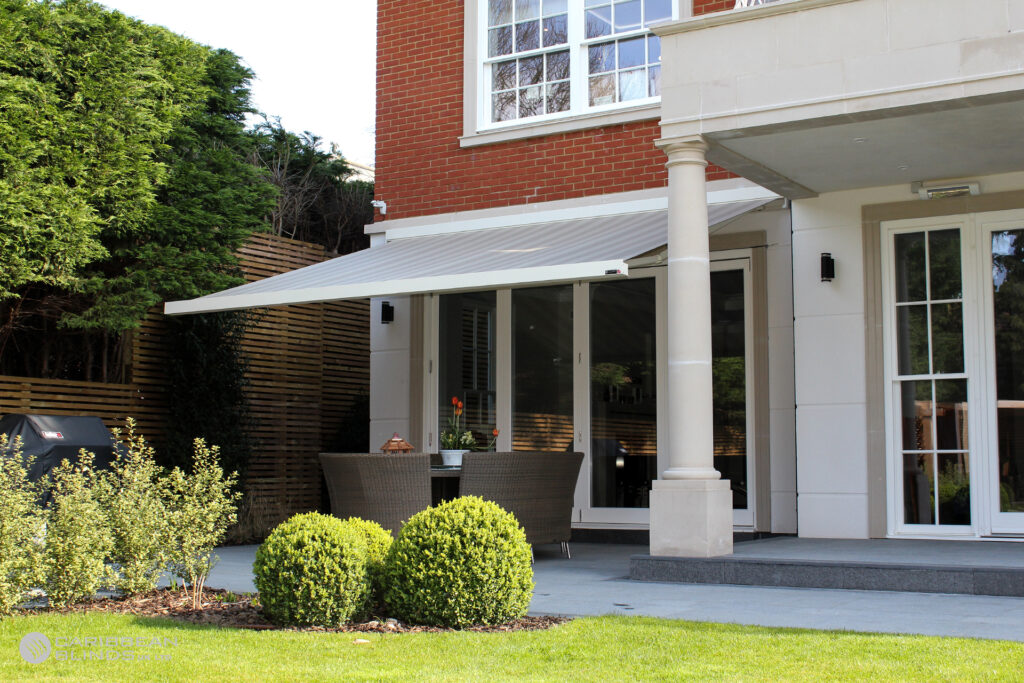

Patio awnings, if set with a suitable pitch, can be used to provide shelter from rain showers. To guarantee rainwater runs off and does not pool on the material, patio awnings must be set with a pitch of 14 degrees (or greater), as set out in European Directive EN13561. As an additional benefit, thanks to the exclusive TEXgard nanotech coating impregnated around every fibre of our materials, as the rainwater runs off, it will remove all loose surface dirt and debris ensuring the material keeps a clean visual appearance.
The chart below shows the fall of a patio awning over its projection when set with the optimum 14-degree pitch, along with the required mounting height on the façade to facilitate this pitch and achieve the typical 2m walk under leadrail height when the awning is extended. The pitch of a patio awning can be varied from as little as 0 degrees up to as much as 45 degrees (dependent on model) to accommodate all property styles, available wall space, required leadrail heights along with use.

Patio awnings with a wet fabric (used in rain) should be allowed to dry out first before you retract them away, however, if the fabric is rolled away wet (ie the rain is persistent), the patio awning should be opened up at the next opportunity to allow the fabric to properly dry out and to help minimise any rippling and waviness in the material. Continuous and consistent use of a patio awning in rain showers will affect the look and appearance of the fabric.
Single storey buildings, including extensions and bungalows, pose two main issues when it comes to installing patio awnings; limited mounting space above the top of the patio doors/window and lack of structural strength at the top of the wall where the awning needs to be attached/positioned. However, with specially designed brackets, these obstacles can be overcome and patio awnings safely and securely installed with a good mounting height and subsequently pitch (angle).

Spreader Plates (pictured above)
Spreader plates are typically used on single-storey extensions where there is adequate space above the doors/windows to position a patio awning. Spreader plates, as the name suggests, spread the fixing load created by patio awnings safely down the façade, whilst positioning the patio awning to the top.
It is important to remember that while there may be the required space for a patio awning above the doors/windows, it may not allow for a suitable pitch, so cantilever brackets as detailed below will most likely be required.

Cantilever Brackets (pictured above)
Sometimes referred to as gutter brackets, cantilever brackets are typically used on bungalows where there is not sufficient space above the doors/windows to position a patio awning. They are similar to spreader plates, in that they spread the fixing load created by the patio awning safely down the façade but they wrap around the fascia, positioning the patio awning in front of the guttering, ensuring a sensible mounting height and subsequently pitch for the patio awning.
Cantilever brackets are also regularly used on two storey properties where the upper section is hanging tiles, mounted to the brickwork beneath but positioning the patio awning higher up the façade, in front of the hanging tiles.
Our patio awnings have been designed and constructed from high-quality materials with premium coatings and concealed elements, meaning the only maintenance required is a little TLC (cleaning) from time to time. Corrosion-resistant aluminium profiles and stainless steel components featured on our patio awnings do not rust. Integrated motors concealed within the fabric barrel stay protected from the elements and the unique NANO tech coating featured on our materials prevents the impregnation of dirt and other environmental influences in the fabric.
To keep patio awnings looking like new and to ensure they keep protecting you we would suggest that both the fabric and hardware (metalwork) is hosed down (garden hose, spray setting) on a regular basis (at least twice per year) to remove any loose dirt and more stubborn stains removed using a sponge and mild soapy (circa 2% acidic) water solution. Birds mess and tree sap should be cleaned off immediately on siting to prevent them damaging the hardware/fabric.
When cleaning your patio awning never use any abrasive cleaners, rough cloths (ie scourers) or stiff brushes as this will damage the protective coatings to both the fabric and hardware and always allow the fabric to dry off before retracting your patio awning away.
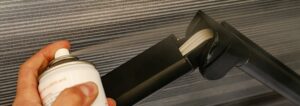
It is also recommended to keep your patio awning opening and closing smoothly with no squeaks that the pins which connect the folding arms at the rear and front along with the pin in the elbow joints of the folding arm are sprayed with a non-corrosive silicone spray to lubricate (pictured at top).
In the majority of instances, planning permission is not required to install a patio awning on the rear of a residential property, as these fall under permitted development rights. There are some exceptions however, including where your property is located in a conservation, green belt or AONB (area of outstanding natural beauty), your property is listed and where permitted development rights have been removed (usually in historic locations to protect the character of an area). Your awning should not extend over or encroach your neighbours boundary and additionally must not be positioned so that rainwater will run off or drain onto your neighbours boundary either.
As every local authority regulations vary, there is no one rule for all, so if you are unsure it is always recommended to check with the local authority.
The correct installation of a patio awning is as important as the quality of the patio awning itself. Containing powerful spring-loaded arms and weighing in some instances more than 100kg, a patio awning, in essence, is like a sail on the side of your property, exposed to gusts of winds and all kinds of strains and stresses.
As a patio awning extends and retracts it creates hi-torque at its load points (where the arms attach to the inside of the patio awning at the back) and subsequently this strain is put onto the fixing plate directly behind. Couple this with the additional stress created from acceptable wind levels and gusts of stronger winds and this load can be as great as over a third of a tonne which is spread across 3 – 6 fixing bolts in each bracket dependent on the patio awning model and size.
Buildings, in theory, are not designed to have patio awnings on the side of them, projecting out in some instances up to almost 4m, however, by using the correct anchoring method patio awnings can be installed safely to virtually any property.
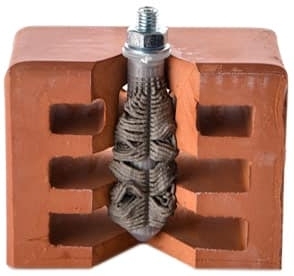
All our patio awnings when fixing to masonry facades are installed using resin bonded anchors (threaded steel rods), which provide a stress-free anchorage which is usually stronger than the base material itself. Commonly used for the anchoring of structural steel such as columns, beams, safety barriers and railings, resin bonded anchors provide a premium anchoring solution with maximum load capabilities. Unlike bolts that grip, including rawl/sleeve/anchor, which have the potential to come loose over a period of time or cause weaker bricks/blocks to crack with the resultant effect of the awning pulling away from the wall with horrific consequences, resin bonded fixings form part of the structure they are attaching to and therefore the fixing itself will never pull away.
Not only does resin fixing take considerably longer to do than grip bolt fixings but it costs more too (hence why most companies use cheaper, faster mechanical fixings) however, it guarantees, the safest installation of a patio awning to your property.
The resin fixing process
Resin is injected into the hole drilled for the anchor (which must be thoroughly cleaned out for the resin to set). Two chemical components mix together through the vanes in the tube nozzle before it enters the hole and seeps into the pores of the base material when the anchor is then inserted. When the resin is cured, which depends on the temperature of the brick/block, they have formed a stress-free bond of the anchor (threaded steel rod) to the brick/block which they are inserted.
Our exclusive patio awning fabrics are impregnated with the most advanced TEXgard coating; an invisible protective shield around each individual fibre which creates a surface structure similar to the microstructure found on a lotus leaf. Closely arranged NANO chemistry carbon fluoride chains prevent dirt and water from clinging to the fabric surface generating a self-cleaning effect. Loose dirt will still accumulate on the surface but when it rains (and you’re guaranteed that in the UK) the dirt is washed off, leaving a clean, dry fabric.

Substances, such as birds mess and tree sap which ‘stick’ to the fabric should be hosed off immediately to avoid any damage to the protective coating and for dried-on sticky debris a sponge and mild soapy (circa 2% acidic) water solution should be used to clean it off, which then should be rinsed with clean water to ensure that no soapy remnants stay behind on the material and the material allowed to dry off before retracting the patio awning away.
All our patio awnings are bespoke, made to measure to your exact requirements and therefore the cost varies significantly depending on the model, specification (size, hardware colour, operation type…) property type (house, extension, bungalow…) and subsequent mounting brackets, along with any options (lighting, heating…).

The chart below details the typical from and to prices for the different model awnings (without options eg lighting and heating) installed to two property types; houses, where the awning can be installed direct to the brickwork using standard fixing brackets and extensions / bungalows where an awning has to be installed using bespoke load bearing spreader / cantilever brackets to guarantee a safe attachment.
To obtain a budget cost for your specific requirements is really simple using our estimate form, where you simply need to upload a photo of your application, which helps us understand the property type and subsequent mounting detail and some approximate measurements and then one of our estimators will be able to provide you with an accurate cost indication.
Our patio awnings are designed and built to withstand the elements, including strong breezes and occasional gusts of winds. European Directive EN13561, which all patio awnings must be certified to, details different wind classes (class 1, 2 & 3) and confirms the suitability of a patio awning in different wind conditions.
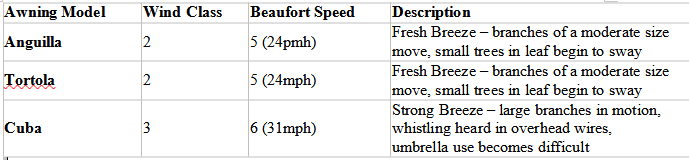
The chart below shows the classes each of our model patio awnings has been certified to, including a description of the acceptable wind levels. It should be noted that the wind class rating is based on the biggest size awning in the range, so in the case of our Anguilla & Tortola model awnings 5m x 3m and Cuba model awning 7m x 3.75m (single module)

As a general rule of thumb, if you feel comfortable sitting under a patio awning and your furniture is not blowing around in the wind, the patio awning should be perfectly fine. The fabric on patio awnings should be relatively still but if it is flapping around and the mechanism is flexing this is a sign that it should be retracted. It is important that a patio awning is retracted away before high wind levels or extreme weather is expected as even retracting a patio awning away during high winds can cause damage.
Electric awnings can be equipped with wind sensors that detect the wind speed levels, automatically retracting an awning should strong winds exceed safe levels. Whilst these sensors are not a fail-safe device, they do offer additional protection and peace of mind and therefore are highly recommended to protect both your patio awning and property.
Under no circumstances should anything be hung from patio awnings and be sure when retracting your patio awning that there are no foreign objects in the way (ie small broken twigs sitting on the fabric) or allowed to roll within the fabric/cassette. Patio awnings are not designed to be left out in gale force wind speeds or adverse weather conditions of any description including hale, snow, frost, thunderstorms, lightening etc.
The CE marking is a declaration by the manufacturer (in this instance us – Caribbean Blinds UK Ltd), that their products meet all the appropriate provisions of the relevant legislation implementing certain European directives. It is a form of safety tests to give the purchaser peace of mind that the product they are purchasing meets high levels of safety and quality standards and are fit for purpose.
All patio awnings must carry the CE marking to show they meet minimum standards as set out in European Directive EN 13561 titled ‘External Blinds – Performance requirements including safety’. There are 19 different sections, however, the key mandatory section is wind resistance. There are 3 classes within the test: Class 1 – Beaufort 4 (17mph) wind resistance, Class 2 – Beaufort 5 (24mph) wind resistance, Class 3 – Beaufort 6 (30mph) wind resistance. The test is carried out by applying weights (which simulate different wind loadings) to the framework of the largest size patio awning within each particular range, releasing them and testing for damage
All our patio awnings have been tested by the renowned independent quality standard body TÜV and certified to either class 2, which equates to a fresh breeze or the highest class 3, a strong breeze. The chart below shows our different patio awning models and their certification rating.
Additionally, this test standard also looks at the resistance to water pocket of the fabric. This test states for an incline of 14 degrees which corresponds to a slope of 25% that the extended material shall withstand the force created by a possible retention of water or the water shall drain off to avoid forming a pocket of water. All our patio awnings when set with this angle (or greater), the rainwater simply beads and runs off, with the additional benefit, thanks to the exclusive nanotech TEXgard coating generating a self-clean effect, taking all the surface dirt and debris with it ensuring the material keeps a clean visual appearance.
Our patio awnings are built to last a lifetime and we are pleased to offer therefore an industry-leading fully comprehensive 5-year guarantee* covering parts, labour and our workmanship. The guarantee covers the complete patio awning system including framework (hardware), mechanism (folding arms), fabric (material) and electronics (motors, transmitters and sensors). All accessories including under awning lighting, infra-red heaters and bespoke brackets come with a 12-month guarantee. So in the highly unlikely event of anything going wrong within the guarantee period, you are fully covered, there are no call out charges or hidden costs to pay.
Our patio awnings should be cleaned and maintained on a regular basis as per the provided operation and maintenance instructions to ensure a smooth, effortless, reliable functioning day in day out and guarantee years of hassle-free use and pleasure. As with all guarantees fair terms apply, for example, we don’t cover misuse of the product, such as use in adverse weather conditions or where items have been hung from the framework and it does not cover fair wear and tear or the batteries in the handset).
Once the guarantee period has expired should there be any issues, we still service and maintain your patio awning for a small call out fee.
The mounting height of a patio awning is determined by the required leadrail (walk under) height and the pitch the awning is required at. Subsequently, the pitch is determined by the use of the awning.
Patio awnings along with being used for sun protection are also used to provide shelter from rain showers. To ensure rainwater runs off and does not pool on the fabric, a patio awning must be set at 14 degrees (or greater). Also from an aesthetics perspective, at 14 degrees patio awnings visually look correct, not too steep or not too shallow. Obstructions and limitations on the façade such as protruding pipes, Juliet balconies and single-storey buildings will also impact the mounting position meaning it is not always possible to obtain a 14-degree pitch.
The chart below shows the mounting height of a patio awning with the optimum 14-degree pitch (bold) along with minimum 5 degree and maximum 38-degree pitch (based on our Cuba Awning). These are based on the awning having a 2m leadrail (typical walk under) height when fully extended.

If a higher or lower leadrail height is required than the typical 2m (used for calculating the mounting heights shown above), simply add or subtract the extra figure from the mounting heights above (ie if the leadrail is required at 2.1m add 10cm onto the above mounting height figures).
Dating back to the Victorian times (mid-1800’s), awnings were initially used, before air conditioning was even invented to shade what was at the time elaborate glass shop frontages, passively cooling the interior of buildings and today still serve the same purpose in a commercial environment.
Nowadays patio awnings along with passively cooling the adjoining interior space are used to provide shade to the outdoor space along with shelter from rain showers when correctly specified with the appropriate pitch. Modern fabrics offer high levels of UV protection, blocking a minimum 95% of the suns damaging UV rays, in turn protecting skin from sun damage and fixtures and furnishings from bleaching. Additionally, bright light is diffused to prevent glare to both the area beneath the awning along with internal space in particular on tv/computer screens. Furthermore, patio awnings provide privacy from overlooking buildings.
Patio awnings are a firm favourite on the back of homes, extending the living space along with outside restaurants to provide alfresco dining spaces. They are a striking addition to buildings of various styles, adding a new dimension and many functional uses.
The pitch (angle) of a patio awning is set at manufacture/installation and can be as little 0 degrees (completely horizontal) up to as much as 45 degrees (dependent on model). The pitch is determined by the leadrail (walk under) height when the awning is fully extended and the mounting height of the awning on the façade. The higher the mounting height and lower the leadrail height, the steeper the angle, subsequently offering greater sun protection to both the area beneath the awning and adjoining internal room when the sun is overhead.
With our unpredictable British climate, patio awnings are not just used for sun protection, but also to provide shelter from those unexpected and often persistent rain showers. To guarantee rainwater runoff, patio awnings must be set at a pitch of 14 degrees (or greater) as set out in European Directive EN13561. This ensures water runs off and does not pool on the material. Additionally, thanks to the exclusive TEXgard nanotech coating impregnated around every fibre of our materials, as the rainwater runs off, it takes surface dirt and debris with it.
Therefore the optimum angle for a patio awning in terms of function, along with aesthetics is 14 degrees. This means that for every metre the awning projects out, it falls 25cm. So based on a popular 3m projection awning, with a typical 2m leadrail (walk under) height, when the awning is fully extended, it would be sited at 2.75m on the façade, when set with a 14-degree pitch.
Our electric patio awnings with or without LED under awning lighting draw around 1.1amps, although at start up (activation of motor) this draw can double circa 2.2amps. The tubular motor, which is built inside the patio awning contained in the rollertube to either the left or right-hand side, has a sealed standard 3 core, (live, neutral, earth) black power cable, exiting it, which is 5m in length.
The power cable is simply fitted with a 3 or 5amp fused rated 3 pin plug and plugged into a standard socket or wired into a standard fuse spur again fitted with a 3 or 5amp fuse. Given the typical mounting height of a patio awning (around first-floor level) it is normal for the power cable to run through a sealed capped hole into the adjacent first-floor room (bedroom) and be plugged into a spare socket here.
When an awning is fitted with an infra-red heater, an additional socket or fuse spur is required to connect the heater to, which should be fused at 13amp, as the heaters draw 2kw each.
A motor power cable is never cut shorter than 1m, as the first 1m of the power cable contains the antenna for the awning motor and cutting this reduces the operating range which is typically 200m in open space or 20m through two reinforced concrete walls but can vary due to local electronic devices such as phone masts.
The width and depth (projection – arm size) of a patio awning are vital to it serving the function it is required for. There are a number of considerations that should be taken into account including use (outdoor dining, internal shade), property aspect, surrounding factors (trees, fences), obstructions (soil pipes) and aesthetics. however, as a general rule of thumb, patio awnings should be sized as follows:

Width
The width of a patio awning is the measurement from outside to outside of cassette casing. The fabric itself is anywhere between 170mm-220mm less in width (dependent on model) as it has to fit within the cassette casing.
As the sun is constantly moving, rising in the East and setting in the West, to offer a good level of sun protection both beneath the patio awning and to the adjoining internal room, when the sun is not overhead, it is recommended to have the patio awning overhang the doors or window it is covering by a minimum of 0.5m (50cm) each side, so 1m (100cm) overall greater than the door/window it is covering.

Depth (Projection – Arm Size)
The projection of a patio awning is the size (depth) of the folding arms. The greater the depth, the greater the shelter to the outdoor space along with shade to the indoor space, particularly from low Winter sun.
Depending on the use of the outdoor space, will determine the projection of a patio awning. For a small-size table, a projection of 2.5m is adequate, however, for a family with a larger table or for people who entertain, a minimum projection of 3m should be realised.
Remember temperatures reach their highest level around noon and the sun’s damaging UV rays strongest between the hours of 10 am – 3 pm. The sun is lower in the sky in winter but rises earlier and sets later in the summer. Make sure you check the movement of the sun around your property, see how trees, objects and other structures (fences) affect how the sun’s shadow falls on your patio area and adjoining internal room.
Our patio awning fabrics are high-performance materials designed to provide both a functional and decorative role, however, despite meeting the highest European standards and laboratory tests, they can only be manufactured to a limited degree of perfection even with today’s state of the art machinery.

Waviness and rippling occurs both around the seams (where the panels of fabric are joined – every 1.2m) and along the side hems (where the fabric is folded on the sides) due to the arrangement of the made-up patio awning fabric, with double layers/thicknesses of material where the fabric is joined (seams) and where it is folded (side hems). This results in the fabric assuming two different diameters around the rollertube.
The tension put on the fabric by the powerful spring-loaded folding arms causes the areas where there are double thicknesses of material (seam, side hems) to press down harder on each other resulting in waviness and rippling immediately adjacent to the seams/side hems. This effect also occurs in the centre of the panel when water is allowed to gather on the fabric forming a trough of water in the material, along with the use of patio awnings in windy conditions, which puts additional pressure and strain on the fabric seams and hems.
This particular natural characteristic is more noticeable on plain (solid) coloured patio awning fabrics with mid-dark fabrics including warm reds, royal blues, forest greens etc the most noticeable. Striped patio awning fabrics tend not to highlight this characteristic as much due to the varied colours of the stripes which ‘hide’ to a degree the waviness/rippling that occurs with all patio awning fabrics.
Our patio awnings feature between 2 – 6 (depending on model & width) folding arms each containing 2 heavy-duty double coiled internal springs. These springs are stretched (put under tension) when they are folded back and therefore want to push the patio awning open so they can return to their natural (un-stretched) positions. This is what extends the patio awning when operated and what ensures the fabric stays taut at every position.
There are two key ways to tension the springs within a folding arm, via either a chain (similar to a bike) or tear-resistant stainless steel cables. Whilst both methods of tensioning the springs can put the same tension on the fabric, there is one big difference – the weakest link.
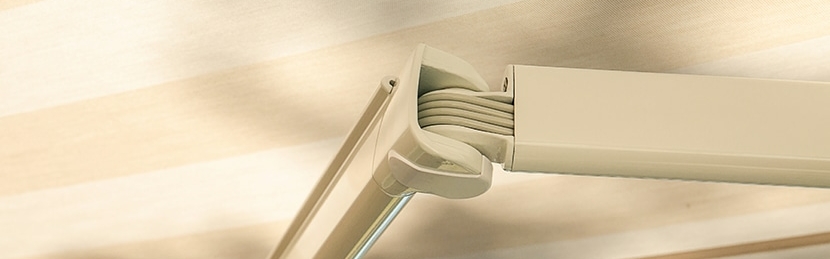
In cable tensioned folding arms, the tension the springs create is spread throughout the entire length of the intertwined stainless steel cable, with the cable directly connecting and looping around the end of the spring, returning back on itself.
On a chain-tensioned arm, the tension the springs create is put on the links between each section of the chain, with the highest pressure on the first link, meaning the arm is only as good as the weakest link.
All our patio awnings feature cable tensioned arms using between 2-4no. heavy duty tear-resistant stainless cables for optimum tension, which are sheathed, so if the patio awning is used only part open they are visually pleasing to the eye.